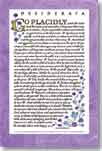
Few
people seem to know who wrote it – or when
by Sam McGarrity, Guideposts Associate
Editor
Desiderata – a poetic formula
for happiness, a gentle urging to be at peace with God and
with life – is known and loved the world over for its
words of reassurance. Its message, heralded on posters and
plaques hanging in homes and over desks, has comforted and
inspired millions of people. Television audiences have heard
it from the lips of Ali McGraw, Johnny Cash and Joan Crawford.
Ann Landers' readers have found it in her column.
It's been printed in Reader's Digest, Good Housekeeping
and New Woman, and in the sixties hippies passed it out on
street corners. In 1972, it was recorded as a narrative song
that sold more than a million copies. It's been recited at
weddings and funerals, and just before his death, Adlai Stevenson
had planned to use it as his Christmas greeting.
The wealthy, the poor, the famous and the infamous have used
Desiderata as a guide in changing their lives for
the better. Affluent attorneys attest to this. So do ex-convicts
and ex-drug addicts. It has been used in drug rehabilitation
programs. It has been shared in schoolrooms, in courtrooms.
There's even a woman on Park Avenue in New York who has it
printed on her hostess apron.
Yet, in spite of the fame of Desiderata, few people
seem to know the true story of its origins. In fact, many
people think, mistakenly, that it was written in the 17th
century and inscribed on a wall at St. Paul's Episcopal Church
in Baltimore. How surprised they are to learn that it was
actually written in 1927 by a stocky, middle-aged, Indiana
attorney named Max Ehrmann.
The confusion began one Sunday in the late-fifties. The Reverend
Frederick Ward Kates, then rector of St. Paul's, liked to
distribute copies of inspirational pieces to his parishioners.
That particular Sunday he placed Desiderata in the pews; it
was printed on the church's letterhead, which contained the
church's date of founding: 1692.
It is thought that the mimeographed copies passed from hand
to hand, until it landed on the desk of an editor. Seeing
the date 1692, the editor assumed the piece was in the public
domain, had Desiderata printed up, stuck the name
of the church and the date underneath, and so began a massive
theft of a copyrighted, contemporary work.
This created a costly and frustrating predicament for Robert
L. Bell, who in 1967 acquired the copyright to Desiderata
at great financial risk. "At the time," recalls
Bell, "I was president of Bruce Humphries, a publishing
company that was starving for lack of capital, which owned
the publishing rights to Desiderata and which owed me $16,000
in back salary. I was having an incredible struggle trying
to support my wife and four children, one of whom was in college."
"I owned loans against Bruce Humphries and, in a court
procedure, agreed to relinquish my liens in exchange for the
publishing rights to Desiderata. Then I took every
cent I had and bought the copyright from Richmond Wight, nephew
and heir to the Ehrmann works."
More Historical Facts
Mr. Ehrmann, who was born in 1872, entered Harvard's School
of Philosophy at the age of 22. He studied philosophy and
law, spent ten years writing six books and finally, when he
realized he could not make a living as a writer, began practicing
law. Later he became deputy prosecuting attorney in Terre
Haute.
He composed Desiderata out of the need
to remind himself how he wanted to live his life. The title
is Latin for "things to be desired."
He died in 1945. Three years later his
widow included Desiderata in The Poems of Max
Ehrmann, published in 1948 by the Bruce Humphries Publishing
Company, of Boston.
The Rev. Halsey Cook, rector of Old St. Paul's, told inquirers
that no literary work of any kind could have possibly have
been found in St. Paul's Church in Baltimore in 1692, because
the church did not then exist. St. Paul's parish was established
in 1692, but its first crude log church was not erected until
the following year.
A Baltimore authority on early English literature said, "This
work, as it reads now, was not written in 1692. The words
are not those of the seventeenth century, nor is the composition."
Other sources of Desiderata
Desiderata, a poem for a way of life is available
for purchase in hardcover at Amazon.com. "This classic
book of inspiration has sold more than 190,000 copies and
continues to give comfort and cheer to new readers year after
year." Max Ehrmann's other books, The Desiderata
of Love, The Desiderata of Happiness, The
Desiderata of Hope, and The Desiderata of Faith
are also available at Amazon.com
Les Crane's record of Desiderata is available as an audio
CD thru Amazon.com.
|